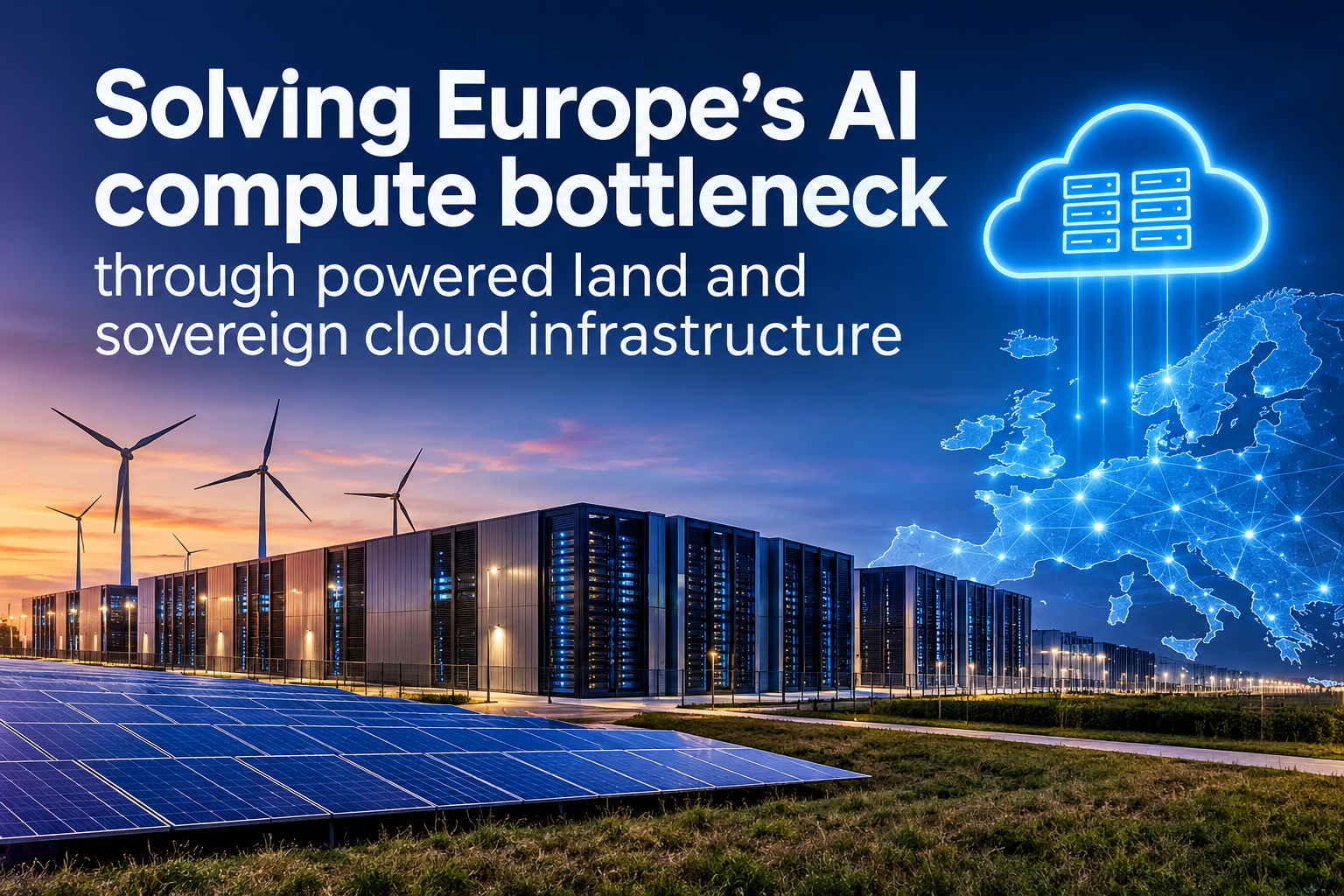
Sovereign wealth funds, hyperscalers, and enterprise buyers are committing unprecedented capital to European artificial intelligence and sovereign cloud infrastructure. Across Germany and the wider continent, enterprises and public bodies are moving critical workloads into locally governed environments to safeguard data residency and operational autonomy.
Yet capital alone cannot generate megawatts. In primary German hubs such as Frankfurt, Munich, and Berlin, high-voltage grid interconnection has become the single hardest constraint on new capacity. Data centres already account for roughly 40 percent of Frankfurt's municipal electricity demand, leaving virtually zero immediate power capacity inside the city and pushing grid connection lead times out by three to seven years. Combined with stricter German Energy Efficiency Act requirements on power usage effectiveness and waste-heat reuse, developers face a structural bottleneck.
Where immediate deployment opportunities exist
Because greenfield sites without secured power face multi-year delays, institutional developers and sovereign-backed platforms are actively shifting toward assets that bypass traditional grid queues.
-
Commercial land with secured high-voltage power: Parcels in surrounding Rhine-Main, Bavarian, Brandenburg, and wider European corridors that already hold utility-approved grid connections or substation capacity command a substantial scarcity premium.
-
Brownfield industrial conversions: Decommissioned manufacturing plants, logistics hubs, and heavy industrial sites often possess existing high-voltage infrastructure, water access, and industrial zoning that shorten delivery timelines compared with pure greenfield builds.
-
Regional fibre and colocation operators: Independent edge data centres and regional fibre networks provide immediate sovereign cloud hosting, low-latency inference capacity, and platform acquisition opportunities for institutional buyers scaling across Europe.
How HPCCC connects infrastructure buyers and asset owners
At HPC Consultancy Ltd (HPCCC), we operate at the intersection of institutional capital and physical infrastructure. Through our network of 800 local consultants across Europe, the UK, the Gulf, and Asia, we source off-market assets and introduce principals directly under strict confidentiality.
-
For landowners and industrial asset holders: If you hold commercial land with confirmed high-voltage grid allocations or a brownfield industrial facility suitable for data centre conversion, HPCCC can introduce your site discreetly to vetted sovereign-backed developers and infrastructure funds.
-
For regional colocation and fibre operators: Owners considering a strategic sale, majority recapitalisation, or £5 million to £50 million in non-dilutive expansion debt can engage HPCCC to connect with institutional acquirers and private credit lenders.
-
For infrastructure funds and sovereign sponsors: Capital allocators seeking powered land banks, conversion-ready industrial sites, or regional platform acquisitions across Germany and Europe can register their technical power and latency mandates with our team.
To discuss an off-market site, regional operator mandate, or infrastructure acquisition requirement in confidence, contact HPC Consultancy Ltd today.
Frequently asked questions for United Kingdom businesses on AI data centre infrastructure, sovereign cloud, and global markets
1. What AI data centre and sovereign cloud infrastructure opportunities can businesses in United Kingdom access through HPC?
Through HPC Consultancy Ltd, companies and infrastructure sponsors in United Kingdom can access off-market commercial land parcels with secured high-voltage power capacity, brownfield industrial sites suitable for data centre conversion, and regional fibre and colocation operators across Europe.
2. Why is high-voltage grid interconnection a major bottleneck for European AI compute capacity?
In primary European hubs such as Frankfurt, Munich, and Berlin, grid connection queues and tight municipal power capacity delay greenfield builds, giving a significant timing advantage to sites that already hold approved high-voltage power allocations or existing industrial connections.
3. How does HPC support businesses in United Kingdom looking to buy, sell, or fund data centre assets?
HPC acts as a commercial intermediary across 86 countries, connecting landowners, brownfield site holders, and regional colocation or fibre operators in United Kingdom and Europe with vetted institutional acquirers, sovereign-backed developers, and private credit lenders under confidentiality.
4. How can regional colocation and fibre operators in United Kingdom raise expansion capital without giving up equity?
Operators in United Kingdom seeking £5 million to £50 million for capacity upgrades, fibre rollouts, or refinancing can work with HPC to access institutional direct lending facilities tailored to cash-flowing digital infrastructure.
5. How do London Stock Exchange AI infrastructure IPOs affect European data centre valuations?
Listings such as London Stock Exchange AI infrastructure IPOs following LIAN Group selecting London for its planned $500 million AI data centre listing highlight strong public market appetite for scalable compute infrastructure and provide clear valuation benchmarks for private operators.
6. How do UK capital markets listing reforms and exchange competition against European venues for international tech issuers affect growth companies?
UK capital markets listing reforms and exchange competition against European venues for international tech issuers give scaling technology and infrastructure businesses more flexible routes to public capital once they reach institutional scale.
7. How do strategic corporate buyers competing with private equity sponsors on UK public-to-private takeovers influence sector M&A?
Strategic corporate buyers competing with private equity sponsors on UK public-to-private (P2P) takeovers show trade buyers moving decisively to secure critical infrastructure and technology platforms.
8. How do GP-led continuation vehicles, cross-fund transfers, and minority stake sales support infrastructure and tech sponsors?
GP-led continuation vehicles, cross-fund transfers, and minority stake sales for private equity liquidity allow sponsors to retain high-performing digital infrastructure and industrial assets beyond traditional fund lifecycles.
9. Why is UK withholding tax planning on private credit interest payments ahead of the proposed rise to 22% in April 2027 important for corporate borrowers?
UK withholding tax planning on private credit interest payments ahead of the proposed rise to 22% in April 2027 helps businesses in United Kingdom and cross-border lenders structure treaty relief and debt terms efficiently before higher rates take effect.
10. How do middle-market direct lending facilities supporting sponsor-backed continuation funds expand debt availability?
Middle-market direct lending facilities supporting sponsor-backed continuation funds provide dedicated refinancing and capex lines for scaling infrastructure and enterprise platforms.
11. How do UK National Wealth Fund co-investment mandates in defence technology and industrial manufacturing support regional supply chains?
UK National Wealth Fund co-investment mandates in defence technology and industrial manufacturing crowd in institutional capital alongside domestic and international suppliers building sovereign capability.
12. How do bespoke retirement decumulation mandate design and pension risk transfer solutions affect long-term asset demand?
Bespoke retirement decumulation mandate design and pension risk transfer (PRT) solutions reinforce institutional demand for stable, long-dated infrastructure and contracted cash flows.
13. Why are grid-connected battery storage, offshore wind, and data centre power interconnection assets closely linked?
Grid-connected battery storage, offshore wind, and data centre power interconnection assets are increasingly co-located or paired through private wire agreements to secure reliable, clean power for high-density compute campuses.
14. How do FCA operational resilience, cyber risk supervision, and semi-liquid wealth fund rules affect enterprise technology buyers?
FCA operational resilience, cyber risk supervision, and semi-liquid wealth fund rules push financial institutions and enterprise buyers to prioritise sovereign cloud hosting, local data residency, and resilient digital infrastructure.
15. What does European defence and photonics M&A indicate for industrial technology suppliers?
Transactions such as European defence and photonics M&A led by Thales entering exclusive negotiations to acquire a 51.6% controlling stake in Lumibird underline accelerating consolidation across European strategic technology and hardware supply chains.
16. How do European infrastructure debt and equity fundraising closes benefit project developers?
Substantial commitments in European infrastructure debt and equity fundraising closes following F2i surpassing €1.2 billion across new infrastructure funds increase the pool of institutional capital targeting powered land, fibre, and energy transition assets.
17. How do European smaller-cap buyout fundraises and early-stage AI fintech venture fund resizing affect growing companies?
European smaller-cap buyout fundraises and early-stage AI fintech venture fund resizing encourage mid-sized operators to combine disciplined organic growth with non-dilutive debt or strategic partnerships.
18. How does European large-cap strategic M&A resurgence create opportunities for mid-market businesses?
European large-cap strategic M&A resurgence and cross-border corporate acquisitions drive demand for bolt-on regional operators, specialist engineering firms, and local data centre capacity.
19. How do semi-liquid evergreen private credit vehicles and private credit CLO debt tranches support European corporate borrowing?
Semi-liquid evergreen private credit vehicles targeting high-net-worth and European wealth channels alongside private credit collateralised loan obligation (CLO) debt tranches and senior secured middle-market loans expand non-bank credit capacity for European businesses.
20. How do German industrial, defence, and technology infrastructure sovereign-backed acquisitions and EIC STEP Scale Up selections shape European growth?
German industrial, defence, and technology infrastructure sovereign-backed acquisitions and European Innovation Council (EIC) STEP Scale Up equity co-investment selections for deep-tech scale-ups channel sovereign and public-private capital into European sovereign cloud, AI, and manufacturing infrastructure.
21. How do insurance broker consolidation and EU Foreign Subsidies Regulation filings affect cross-border corporate deals?
Insurance broker consolidation and capital-light managing general agent (MGA) platforms alongside cross-border M&A merger control and EU Foreign Subsidies Regulation filings shape how businesses manage operational risk and cross-border regulatory approvals in Europe.
22. What do Asian value-add real estate fundraises exceeding institutional targets signal for industrial and data centre assets?
Strong closes in Asian value-add real estate fundraises exceeding institutional targets highlighted by Invesco surpassing its $1.25 billion target for its Asian value-add real estate fund confirm sustained institutional demand for conversion-ready industrial and logistics properties.
23. How do Indian impact and mid-market buyout fundraises support cross-border business expansion?
Momentum in Indian impact and mid-market buyout fundraises following Lok Capital's $130 million first close toward a $250 million target expands growth capital for mid-market companies scaling regionally and internationally.
24. How do South Korean eVTOL joint ventures and outbound Indian corporate M&A reflect Asian technology expansion?
South Korean eVTOL operations, maintenance, and training ecosystem joint ventures alongside outbound Indian corporate M&A, cross-border IP protection, and global capability centre (GCC) structuring illustrate how Asian enterprises build international operational hubs.
25. How do the HKEX 60/40 index series, Indonesian sovereign wealth fund Danantara revisions, and Vietnam International Financial Centre expansion affect Asian markets?
The Hong Kong Exchanges and Clearing (HKEX) 60/40 index series blending Hong Kong equities with overseas assets, Indonesian sovereign wealth fund Danantara profit forecast revisions and state-backed asset restructuring, and Vietnam International Financial Centre expansion in Ho Chi Minh City and regional private market fund inflows reflect evolving Asian financial hubs and institutional capital flows.
26. How do Taiwan's sovereign wealth fund preparations, Southeast Asian hyperscale AI data centres, and USD/JPY cross-currency basis swaps affect cross-border businesses?
Taiwan legislative preparations for its inaugural sovereign wealth fund and domestic ETF expansion, hyperscale AI data centre equity raises and Southeast Asian power generation capacity, and foreign currency intervention thresholds and USD/JPY cross-currency basis swaps shape compute availability, energy costs, and currency hedging for companies in United Kingdom.
27. What do institutional African carbon credit fundraises mean for corporate sustainability strategies?
Progress in institutional African carbon credit fundraises led by Ardian nearing its €250 million target for its African carbon credits vehicle expands verified carbon-offset and sustainability financing channels for global corporates.
28. How do critical mineral offtake agreements and multi-decade private port concessions support global supply chains?
Critical mineral offtake agreements, permitting milestones, and Final Investment Decisions (FID) for rutile, graphite, and rare earth projects alongside multi-decade private port and logistics terminal concessions tied to mineral supply-chain security strengthen raw-material supply for electronics, batteries, and data centre hardware.
29. How do African data-centre M&A backed by Gulf sovereign wealth investors and AfCFTA alignment accelerate digital growth?
African data-centre and digital-infrastructure M&A backed by Gulf sovereign wealth investors and African Continental Free Trade Area (AfCFTA) regulatory alignment and national fintech consolidation support cross-border cloud and enterprise connectivity.
30. How do African critical mineral platforms, African private credit facilities, pan-African fintech, sovereign eurobond spreads, and Mission 300 power finance create business opportunities?
African critical mineral investment platforms and debt-to-equity mining restructurings, African private credit facilities and larger-ticket institutional debt syndications, pan-African fintech, cross-border remittance infrastructure, and mobile money platforms, sovereign eurobond yield spreads and domestic local-currency treasury bill auctions, and utility-scale renewable energy, green hydrogen, and Mission 300 power project finance expand infrastructure and commercial partnerships across emerging markets.
31. How does Saudi banking liquidity management influence corporate financing across the Gulf?
Saudi banking liquidity management, deposit growth vs credit expansion ratios, and domestic debt capital market deepening highlight how Gulf banks balance domestic project lending with regional capital markets issuance.
32. How do Gulf sovereign wealth fund selective capital allocation and outbound European acquisitions affect European infrastructure?
Gulf sovereign wealth fund selective capital allocation balancing domestic defence/stabilisation with strategic cross-border corridors alongside outbound Gulf sovereign wealth acquisitions in European industrial, defence, and AI infrastructure channels major sovereign capital into European compute and industrial assets.
33. How do GCC debt advisory expansion and Gulf banking consolidation support businesses expanding into the Middle East?
GCC debt advisory expansion and non-dilutive financing amid a slower regional IPO pipeline together with Gulf banking consolidation and all-stock mergers broaden structured debt and banking support for companies operating across the GCC.
34. How do Gulf principal investments in UK/European data centres, Middle East fintech rounds, global sukuk liquidity, LNG offtake agreements, and master-planned urban land parcels shape Gulf partnerships?
Gulf sovereign wealth principal investing in gigawatt-scale UK and European data centre joint ventures, Middle East fintech funding rounds across payments, data intelligence, and Islamic digital banking, global sukuk secondary-market liquidity and sovereign Islamic bond spreads, liquefied natural gas (LNG) long-term offtake agreements and petrochemical downstream assets, and master-planned urban development land parcels and hospitality brand management contracts create cross-border joint-venture and supply opportunities for firms in United Kingdom.
35. What do Australian regulatory enforcement priorities on private credit governance and Takeovers Panel rulings signal for corporate transactions?
Australian regulatory enforcement on private credit fund governance, valuations, and AFS licence suspensions following ASIC's latest funds update and 2027 enforcement priorities, alongside Australian Takeovers Panel rulings on undisclosed shareholder associations and corporate deal deliverability, underscore the importance of transparent governance and clean deal execution.
36. How do US climate and energy transition fundraises and US agribusiness buyouts reflect North American private equity demand?
Closes in US climate and energy transition private equity fundraises led by GEF Capital's $615 million first close and US agribusiness and animal health buyouts highlighted by Paine Schwartz's $315 million acquisition agreement demonstrate steady North American private equity deployment into real-economy sectors.
37. How do Australian managed fund buy/sell spread adjustments and US critical mineral supply-chain security initiatives affect international firms?
Australian managed fund buy/sell spread adjustments and TMX Australia Exchange market-neutral regulatory consultations alongside US critical mineral supply-chain security, price floors, stockpiles, and sovereign offtake vehicles reflect evolving market liquidity rules and industrial supply-chain policies.
38. How do US direct lending spread compression, semi-liquid private credit distribution, PIPE transactions, and US Treasury yield hedging affect corporate borrowing?
US direct lending spread compression, senior secured middle-market software loans, and healthcare non-accrual risk, semi-liquid private credit fund distribution across US retail and wealth management channels, private investment in public equity (PIPE) transactions and institutional growth capital allocations, and US Treasury long-dated yield hedging, Federal Reserve rate-path derivatives, and active fixed-income inflows influence global debt pricing and refinancing windows.
39. Why are brownfield industrial sites attractive for AI data centre conversion?
Brownfield industrial sites often feature existing high-voltage power infrastructure, large structural floorplates, water access, and industrial zoning, enabling faster conversion into AI or colocation data centres than greenfield land waiting for new substations.
40. What technical information should a landowner in United Kingdom or Europe prepare before marketing powered land for data centres?
Landowners should prepare confirmed utility grid connection offers, MVA capacity details, substation proximity maps, site boundaries, zoning status, and environmental or flood-risk assessments.
41. What makes regional fibre and colocation operators attractive to institutional buyers?
Regional fibre networks and edge colocation facilities offer existing enterprise customer contracts, sovereign data residency compliance, and immediate low-latency connectivity that larger platforms can scale.
42. How does sovereign cloud demand differ from traditional public cloud hosting?
Sovereign cloud infrastructure ensures that data storage, AI model training, and operational control remain within strict national or European legal jurisdictions to satisfy regulatory and data-security rules.
43. Can businesses in United Kingdom use HPC to source data centre capacity or hosting partners in Europe?
Yes, enterprises and cloud providers in United Kingdom seeking powered sites, colocation capacity, or regional infrastructure partners across Europe can engage HPC to identify vetted counterparties.
44. How does HPC protect confidentiality when introducing off-market land parcels or regional operators?
HPC puts formal non-disclosure agreements in place before sharing site coordinates, grid connection letters, customer schedules, or financial data with prospective buyers.
45. What role do waste-heat reuse and power usage effectiveness (PUE) play in modern European data centres?
European energy efficiency regulations increasingly require modern data centres to meet strict PUE thresholds and integrate district heating or industrial waste-heat reuse into site design.
46. Can a regional data centre or fibre business in United Kingdom combine growth debt with a minority equity partner?
Yes, HPC can introduce established operators to both private credit lenders offering £5 million to £50 million in non-dilutive debt and institutional equity co-investors.
47. How does HPC verify buyer capability before introducing them to landowners or operators?
HPC reviews prospective buyers' institutional backing, acquisition mandates, and technical development track records before making direct introductions.
48. Are HPC's infrastructure brokerage services limited to Germany?
No, while Frankfurt, Munich, and Berlin face acute grid constraints, HPC covers powered land, brownfield sites, and regional colocation opportunities across the UK, wider Europe, the Gulf, and Asia.
49. What happens after a business or landowner in United Kingdom contacts HPC?
HPC arranges a confidential discovery discussion, executes appropriate NDA and fee agreements, and begins targeted matching with qualified counterparties.
50. How can companies, landowners, or investors in United Kingdom contact HPC today?
Business owners, industrial landowners, and infrastructure investors in United Kingdom can contact HPC Consultancy Ltd directly to outline their asset or acquisition mandate in confidence.